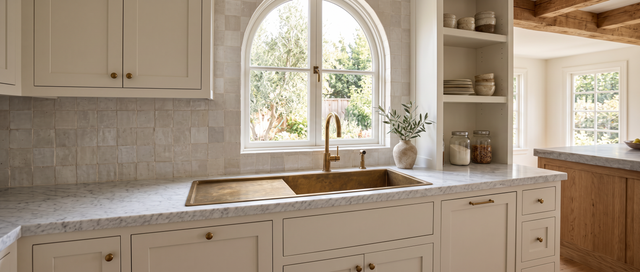
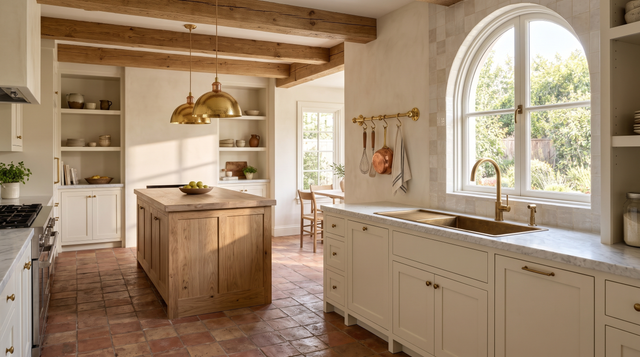
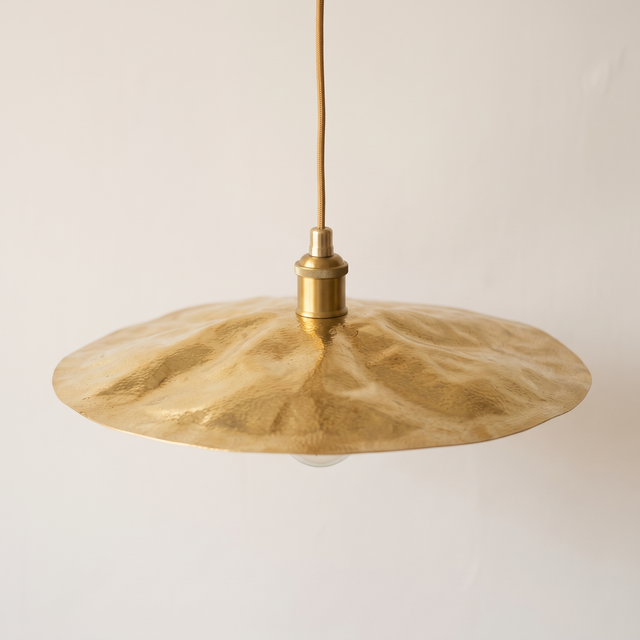
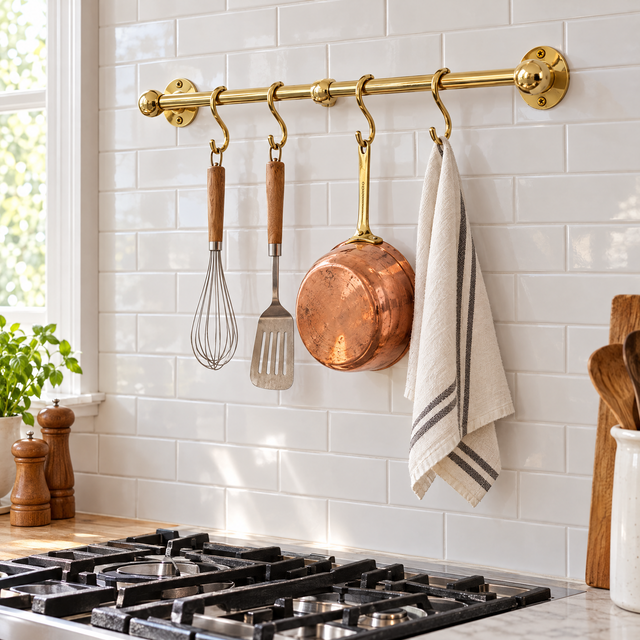


An unlacquered brass kitchen faucet is solid brass with no clear coat, so it starts bright and slowly darkens to a warm, uneven patina wherever water and hands touch it. Before you buy one, know seven things: it will change color (and can spot green if water sits), it must meet the US lead-free rule for drinking water, its mount has to match the holes in your counter, lever handles are easier to live with than cross handles, sprayer options are more limited, hard water speeds up spotting, and prices run from under $200 for a simple handmade faucet to several thousand for designer brands. If you love a finish that records how you live, it is one of the most rewarding things you can put in a kitchen.
We make hand-hammered, unlacquered brass and copper sinks in Fes, Morocco, and our solid brass faucet is cast in Fes too, so these are questions we hear often. Here is the honest version.
In this article
- What is an unlacquered brass kitchen faucet?
- 1. Does unlacquered brass turn green?
- 2. Is an unlacquered brass faucet safe for drinking water?
- 3. Which mount fits your sink: single hole, bridge or widespread?
- How is our solid brass faucet made and finished?
- 4. Lever or cross handles: which is easier to live with?
- 5. Do you need a pull-down or side sprayer?
- 6. How do you care for an unlacquered brass faucet?
- 7. How much does an unlacquered brass kitchen faucet cost?
- How do you pair the faucet with a brass or copper sink?
- Frequently asked questions
What is an unlacquered brass kitchen faucet?
Brass is an alloy of copper and zinc. Most brass-colored faucets in stores are lacquered or plated: the factory seals the surface so the color never changes. An unlacquered faucet skips that coat. The bare metal reacts with air, water and skin oils, so the finish keeps evolving for as long as you own it. Designers call it a "living finish."
Is brass a good material for a kitchen faucet? Yes. Brass is strong, machines cleanly and resists corrosion, which is why it is so widely used for faucet bodies and valves even when the outside is plated chrome or nickel. With an unlacquered faucet, you simply see the brass itself.
| Finish | How it looks over time | Upkeep | Best for |
|---|---|---|---|
| Unlacquered brass | Darkens to a warm, uneven antique tone; can be polished back to bright | Wipe dry, mild soap; polish only if you want shine | People who want character and do not mind change |
| Lacquered brass | Stays the same color until the coating wears or chips | Gentle cleaning only; worn lacquer is hard to repair | A fixed, uniform gold look |
| PVD or plated brass color | Very stable color; does not patina | Lowest maintenance | Busy kitchens that want gold with no change |
If you are still deciding between coated and uncoated metal, our guide to unlacquered vs lacquered brass walks through the same trade-off for sinks.
1. Does unlacquered brass turn green?
It can, in spots. The normal change is a slow shift from bright yellow brass to deeper gold, amber and brown, darkest where water lands and hands grip. Green or blue-green spots (verdigris, a copper corrosion product) appear when water is left to sit on the metal, most often at the base of the faucet, under the spout and around handle joints.
How fast this happens depends on your water, the humidity in your kitchen and how often the faucet is used, so no two faucets age alike. We show what brass typically looks like at each stage in what unlacquered brass looks like after 1 month, 1 year and 5 years.
What to know before buying:
- The warm darkening is the point of the finish. If it would bother you, choose a coated finish instead.
- Green spots are a sign of standing water, not a defect. Drying the base after heavy use prevents most of them.
- In our experience, green spots usually start at the bottom of the faucet, where water collects around the base. Cleaning and drying the base often keeps them from building up.
- You can remove green spots, or return the whole faucet to bright brass, with a gentle brass polish, then let it age again.

2. Is an unlacquered brass faucet safe for drinking water?
A kitchen faucet delivers water you drink and cook with, so lead content matters more here than anywhere else in the house. Under the Safe Drinking Water Act, a faucet sold for drinking water in the US must be "lead free," which the EPA defines as a weighted average of no more than 0.25% lead across the surfaces that touch water (40 CFR 143.12). Manufacturers commonly certify to that limit under the NSF/ANSI 372 standard.
That rule applies whether the outside is lacquered or not. A clear coat on the exterior does nothing inside the waterway, so an unlacquered faucet is not riskier by default. What matters is the alloy and the certification.
Before you buy any brass faucet, especially a handmade or imported one from an online marketplace:
- Ask the seller in writing whether the faucet meets the US lead-free requirement for drinking water.
- Ask what certification or test documentation they can share.
- Be cautious with listings that cannot answer clearly.
Our brass is lead-free, and our faucets are cast in Fes from that same brass. If you would like details for a specific product before you order, just ask us.
3. Which mount fits your sink: single hole, bridge or widespread?
This is where most faucet regrets start. The faucet has to match the holes drilled in your counter or sink deck, and once stone is drilled you are locked in.
| Mount style | Holes needed | Look | Watch out for |
|---|---|---|---|
| Single hole | 1 (plus 1 more for a separate sprayer) | Clean, simple gooseneck | Confirm the hole diameter the faucet needs |
| Bridge | 2 (plus 1 for a side sprayer) | Classic, two handles joined by a horizontal bar | Centers are fixed, often 6 or 8 inches; drill to the exact spec |
| Widespread | 3 | Separate spout and handles | More joints on the deck to keep dry |
| Wall mount | None in the counter; valve in the wall | Clear deck, very traditional | Must be planned before the wall is closed |
An unlacquered brass bridge faucet is the look many people picture, and it suits a farmhouse or drainboard sink beautifully. A single-hole gooseneck is easier to install and keep dry, and it is the natural pick for a bar, prep or island sink. Whatever you choose, get the faucet's spec sheet before the counter is templated and give it to your fabricator.
Also check the connections. Standard US faucets connect with 3/8 inch supply lines. Some imported faucets use different fittings or sprayer arrangements, so confirm compatibility with your plumber before you order.


Solid brass cast in Fes, single hole (1.35 inch hole), one lever for hot and cold, 3/8 inch braided supply hoses included. Polished and brushed finishes are unlacquered; the aged finish is sealed.
How is our solid brass faucet made and finished?
The body of our gooseneck faucet is cast in Fes from the same lead-free brass we use for our sinks: the metal is melted and poured into a mold, then finished by hand. You choose one of three finishes, and they do not all behave the same way over time.
| Finish | How we make it | Coated? | How it changes |
|---|---|---|---|
| Polished | Polished bright on a spinning buffing wheel faced with daim, the soft suede leather our polishers use | No, unlacquered | Starts shiny and develops a natural patina with use |
| Brushed | Brushed by hand or on a spinning brushing wheel for a soft satin grain | No, unlacquered | Softer start, then patinas like polished brass |
| Aged | An acid treatment speeds up oxidation for an antique tone, then it is brushed and lacquered | Yes, lacquered to hold the color | Stays close to how it arrives |
So if you want a true living finish that keeps changing alongside an unlacquered sink, choose polished or brushed. If you want the antique look from day one with less change, choose aged. Because the aged finish is sealed, clean it with mild soap and water only, and skip brass polish and abrasive pads, which can wear through the lacquer.
4. Lever or cross handles: which is easier to live with?
Cross handles look wonderful on a traditional bridge faucet, but in a working kitchen they have two drawbacks. You need clean fingers to turn them, and their spokes and center caps create small crevices where water and grime collect. On unlacquered brass, those crevices are exactly where green spots like to start.
Lever handles can be nudged on and off with a wrist or the back of a hand when you are kneading dough or handling raw meat. They also have fewer nooks to dry. A single lever goes one step further: one motion sets hot and cold, which makes it our pick for the main sink you cook at every day.
5. Do you need a pull-down or side sprayer?
Most unlacquered brass faucets are traditional designs, and traditional designs usually handle spraying with a separate side sprayer rather than a pull-down head. Unlacquered pull-down faucets do exist, but there are fewer of them and they tend to cost more.
- No sprayer: the simplest, cleanest look. A tall gooseneck spout still lets you fill stockpots and rinse a deep basin.
- Side sprayer: keeps the classic look and adds a hose for rinsing corners. It needs its own hole, so plan it before drilling, and check how it connects to your hot and cold lines.
- Pull-down: the most practical for heavy cooks, but the hose and head add parts, and the head is touched constantly, so it will patina fastest.
Whichever you choose, the spout should point at the drain. Misaligning the sink with the faucet is one of the two install mistakes we see most often, and it leaves water splashing against one side of the basin.
6. How do you care for an unlacquered brass faucet?
Care is simpler than most people expect, because you are not trying to stop the change, only to keep it even.
- After use: wipe the faucet and the deck around its base with a soft, dry cloth. Standing water is what causes spots.
- Weekly: wash with mild dish soap and warm water, rinse, and dry.
- Avoid: bleach, harsh chemical cleaners and abrasive pads, which strip patina unevenly and scratch the metal.
- For shine: use a gentle brass polish whenever you want it bright again. The patina starts to return straight away.
Hard water leaves mineral spots on any faucet, and on unlacquered brass those spots show up as uneven toning. If your area has hard water, drying after use matters more, and a water softener can help.
Our Care and Patina Guide has the full routine for brass and copper, and how to clean a brass sink without stripping the patina covers the step-by-step method, which works for the faucet too.

7. How much does an unlacquered brass kitchen faucet cost?
Prices vary enormously because the market splits into distinct groups. The ranges below come from Google Shopping listings for "unlacquered brass kitchen faucet" that we checked in November 2026. Prices change, so treat them as a snapshot.
| Type of seller | Typical listed price | What to check |
|---|---|---|
| Handmade or small-brand faucets sold online | About $170 to $730 | Lead-free status, US fittings, sprayer hookup, returns and shipping time |
| Established designer plumbing brands | About $1,350 to $2,900 | Lead times and whether the unlacquered finish costs extra |
| Our solid brass gooseneck faucet | $189 | Single hole; made to order (2 to 4 weeks production, then 5 to 8 business days in transit) |
The faucet is only part of the budget. Add plumber time, any new counter holes, and a matching drain. A brass basket strainer such as our 3-1/2 inch unlacquered brass strainer ($38) keeps the metal consistent from spout to drain.
How do you pair the faucet with a brass or copper sink?
A polished or brushed faucet over an unlacquered brass sink is a natural pair: both age together, so the tones stay related instead of one looking new and the other old. Over a copper sink, unlacquered brass reads warmer and more golden, which many people like as a gentle contrast. For more combinations, see the best faucet finishes for a brass or copper sink.
A few practical points for the pairing:
- Check the reach and height. In our experience, this is the question customers ask most: will the spout reach far enough into the basin, and, for a vessel sink, is the faucet tall enough for the water to clear the bowl's rim? Measure from the faucet hole to the drain center and compare it with the spout reach. For a vessel sink, the spout outlet has to sit above the rim, so add the bowl's height to your measurements. Our sink sizes are the inside of the basin, excluding the rim.
- Ask us about placement. All our faucets are made to work with our sinks, so the part to plan is where the faucet goes. Tell us which sink you have and we will help you place it.
- Align the spout with the drain. Mark the drain center on your template and place the faucet hole in line with it.
- Let the texture help. In our experience, a hammered texture hides small irregularities and water spots better than a smooth surface, which makes a hammered sink forgiving next to a living-finish faucet.
- Plan the timing. Made-to-order lead times run from about one to three weeks, depending on the product, and in-stock sizes ship from New Jersey. Order the sink and faucet together so neither holds up your install.


Eight sizes from a 16 x 12 inch bar sink to a 45 x 20 inch main sink, with a brass basket strainer included.

Square single bowl in solid unlacquered brass, 24 to 36 inch inside length or a custom size, polished or aged finish.

Round, hand-hammered and unlacquered, in 8, 10 or 12 inch inside diameter. In stock and shipped from New Jersey.
Frequently asked questions
Is brass a good material for a kitchen faucet?
Yes. Brass is strong, corrosion resistant and easy to machine precisely, which is why it is so common in faucet bodies and valves. For drinking water in the US, make sure the faucet meets the federal lead-free limit of a weighted average of 0.25% lead on surfaces that touch water.
Does unlacquered brass turn green?
It can develop small green spots where water is left to sit, usually at the base, under the spout and around handle joints. Wiping the faucet dry after heavy use prevents most of them, and a gentle brass polish removes any that appear.
Can you polish an unlacquered brass faucet back to shiny?
Yes. A gentle brass polish brings back the bright finish whenever you like. Because there is no coating, the patina starts to return right away, so many owners polish only occasionally or not at all.
Is an unlacquered brass faucet hard to maintain?
Not if you accept that it will change. Daily care is a quick dry wipe, weekly care is mild soap and water, and you avoid bleach and abrasive pads. It only feels like hard work if you are trying to keep it looking brand new.
How do I know if a faucet will reach my sink?
Measure from the center of the faucet hole to the center of the drain and compare it with the faucet's spout reach; the stream should land near the drain. For a vessel sink, also check that the spout sits above the bowl's rim. If you are pairing one of our faucets with one of our sinks, ask us and we will help you check.
A living finish, from spout to drain
Solid brass faucets and drains, made to sit beside our hammered brass and copper sinks.
Shop brass faucets →Questions about fit or finish? Ask us before you order and we will help you choose.